
There is a piece of advice that every experienced crowdfunding consultant should give their clients, usually delivered with a firmness that surprises first-time founders: do not launch your raise in late July, August, or from late November through the end of December. Most founders hear it, nod politely, and privately wonder whether it is really that big a deal. The data says it is.
This is not consultant folklore. It is not a hunch dressed up as wisdom. It is one of the most consistent, multi-year patterns in the equity crowdfunding market, and the numbers behind it are substantial enough that ignoring them should be considered a strategic error.
The Summer Trap
Every August, a version of the same story plays out across the Reg CF platforms. Campaigns that launched with momentum in May or June find their weekly investment totals thinning out. Founder inboxes go quiet. Email open rates drop. And the investors who were reliably clicking through in spring seem to have simply… disappeared.
They have not disappeared. They are at the beach.
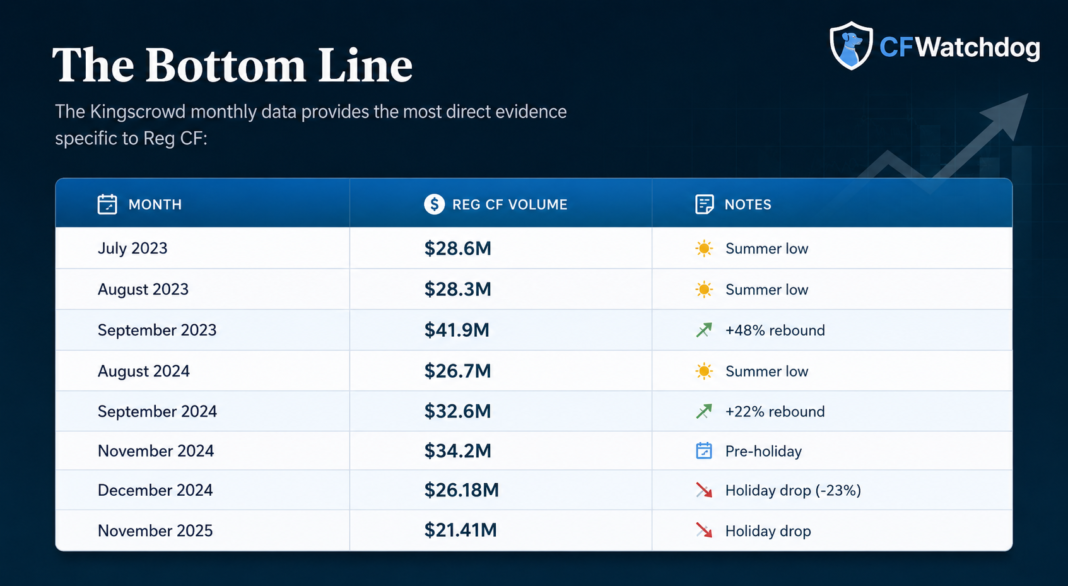
Kingscrowd, which tracks monthly Reg CF investment volumes across all FINRA-registered platforms, provides the clearest picture of how severe this seasonal contraction actually is. In August 2023, total Reg CF net commitments across the entire market came in at $28.3 million, with only three platforms breaking the $1 million threshold for the month. The following month, September 2023, total commitments surged to $41.9 million, with nine platforms exceeding $1 million. That is a 48% jump in a single calendar month, driven by nothing more than the turning of the season.
The pattern repeated with near-identical precision in 2024. August came in at $26.7 million. September rebounded to $32.6 million, a 22% increase. But the weekly data is where the picture becomes truly stark. The final week of August 2024 produced just $5.3 million in total Reg CF investment across the entire market. The first week of September 2024 brought in $9.4 million. That is a 77% jump between two consecutive weeks, separated by nothing but Labor Day weekend.
This is not a 2023 or 2024 anomaly. European investment crowdfunding data confirms the same structural pattern. One major P2P lending platform went from funding nearly €200 million worth of loans in October 2021 to just €35 million in July 2022, with analysts explicitly citing the “usual summer slowdown” in July and August as a primary factor.
The behavioral explanation is well-documented. Summer creates a perfect storm of investor inattention: vacations, school holidays, and reduced workplace schedules all contribute to a collective disengagement from financial decision-making. For institutional and angel investors, the problem is compounded by the difficulty of scheduling partnership-level meetings when key decision-makers are travelling. For retail investors, discretionary attention and discretionary cash both compete with summer spending. Campaigns that need early momentum to trigger social proof and platform algorithmic promotion are particularly exposed, because the investors most likely to be first movers are also the most likely to be distracted.
The implication for founders is direct: a campaign launched in mid-July is not just launching into a slow period. It is launching into a period when the momentum it needs to survive will be hardest to generate, and doing so right before the market’s most active post-summer window. September and October have consistently been among the strongest months for Reg CF investment volume across multiple years of data.
The Holiday Window Problem
The end-of-year pattern is more nuanced, and it catches founders off guard more often than the summer slowdown does, because the conventional wisdom on the holiday season points in the wrong direction.
Most founders assume that Thanksgiving through Christmas is a generous time. People are in a giving mood. There is money in the air. The problem is that investor attention and consumer spending are not the same thing, and they compete for the same mental bandwidth.
Kingscrowd’s data tells a consistent story. In November 2024, total Reg CF investment hit $34.2 million. By December 2024, that figure had dropped to $26.18 million, a 23% decline in a single month. November 2025 came in at just $21.41 million, with Kingscrowd explicitly labeling the period a “winter slowdown.” January 2026 saw some recovery, but February 2026 declined again, described as investment crowdfunding “continuing its winter slowdown for the second straight month.”
Here is what makes the December picture particularly dangerous for founders: the number of active campaigns does not fall with investor volume. In December 2024, the number of active Reg CF raises reached an all-time high of 569, surpassing the previous record of 561 set in March 2022. More campaigns, fewer investor dollars. For any individual campaign, that is a brutal competitive environment.
The mechanism behind the holiday drop-off is straightforward. Consumer attention from late November onward is aggressively captured by retail spending. Research consistently shows that nearly half of American consumers begin holiday shopping before November, and 62% continue into December. Attention spans contract. The path to discretionary financial decisions lengthens. Investors who might have spent 20 minutes evaluating a new equity crowdfunding opportunity in October are instead spending that time comparing prices on gift sets and booking holiday travel. The wallet and the calendar are simply occupied elsewhere.
The Windows That Work
Understanding when not to raise also clarifies when to raise. The Kingscrowd data, taken across multiple years, points to two reliable high-activity windows: January through May, and September through November. These periods align with when investor attention is most available, when platform traffic is highest, and when the competitive landscape for any individual campaign is most favorable relative to the volume of capital moving through the market.
For founders planning a Reg CF, Reg D 506(c), or Reg A+ raise, this seasonal data should shape not just launch timing but preparation timelines. A September launch requires due diligence filings, platform selection, and marketing infrastructure to be complete by August, not started in August. The summer slowdown is not dead time. It is preparation time.
One final number worth sitting with: the difference between a campaign that launches into a $41.9 million monthly market and one that launches into a $26.7 million monthly market is not trivial. All else being equal, a founder who times their launch to September rather than August is competing for a pool of investor capital that is more than 50% larger. In a market where early momentum is everything, that is not a minor tactical consideration. It is the difference between a raise that builds and one that stalls.
CFWatchdog provides independent data-driven analysis of the US equity crowdfunding market. Nothing in this article constitutes investment or legal advice.