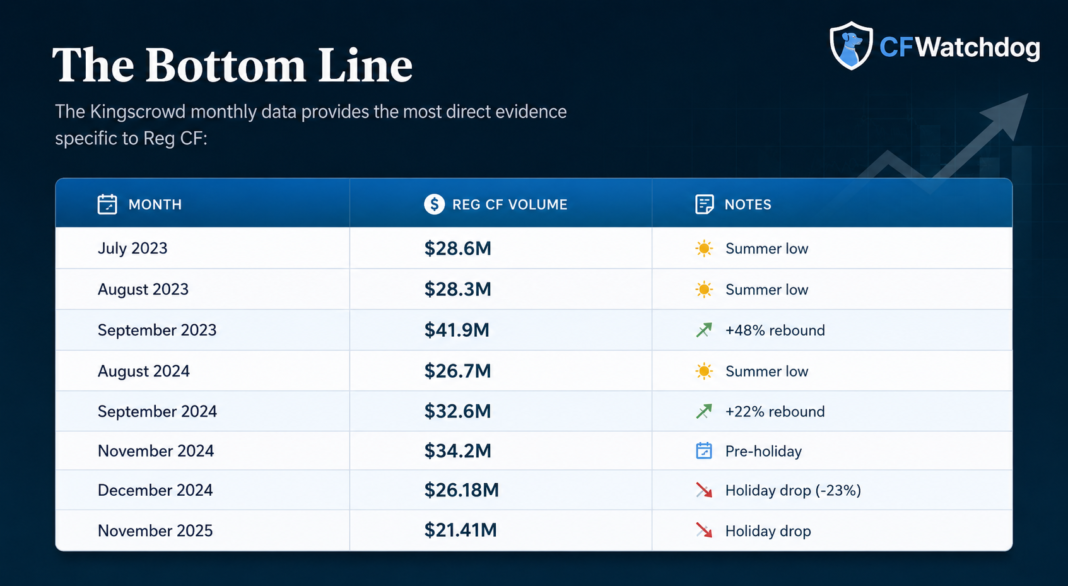

The crowdfunding industry is once again pushing for a dramatic increase to the Regulation Crowdfunding (Reg CF) cap – this time to $20M.
Many portal operators, consultants, and industry participants argue that the increase is necessary for growth, innovation, and market expansion.
I disagree.
And I believe the data, the economics, and the original purpose of crowdfunding all point to the same conclusion:
A $20M Reg CF cap risks fundamentally breaking the very thing crowdfunding was designed to protect.
Let’s Remember Why Crowdfunding Was Created
Crowdfunding was never intended to become a miniature version of Wall Street. It was created to solve a very specific market failure:
Talented founders with promising ideas had little or no access to capital.
The entrepreneur building a prototype in a garage.
The startup overlooked by venture capital.
The small business with community support but no institutional network.
Reg CF democratized capital formation by allowing ordinary people – not just accredited investors – to participate in early-stage funding opportunities.
That was the mission. Not creating a retail-driven substitute for institutional private markets.
The Industry’s Own Data Undermines the Argument for $20M
Since Reg CF launched in May 2016, approximately 8,492 offerings have been filed by roughly 7,134 issuers, according to SEC data.
Now here’s the part that matters.
For most of Reg CF’s existence, the cap was only $1M (later adjusted slightly for inflation).
Even after the SEC increased the cap to $5M in 2021, founders overwhelmingly continued pursuing relatively modest raises.
The data shows:
- Median raise targets historically hovered around $500k–$800k
- Most maximum offering amounts clustered near the original $1M threshold
- An estimated 70%–85% of all Reg CF campaigns since launch targeted less than $1M
That means somewhere between 6,000 and 7,000+ offerings were fundamentally small-company raises.
The market has already spoken.
Reg CF naturally evolved into a mechanism optimized for smaller startups and early-stage businesses. Not $20M raises.
Bigger Caps Do Not Automatically Create Better Companies
One of the most dangerous assumptions in the current debate is the idea that allowing companies to raise more money will somehow improve startup success rates.
It won’t. Most startups do not fail because they couldn’t raise $20M from retail investors.
They fail because of:
- weak product-market fit,
- poor execution,
- unsustainable economics,
- operational inexperience,
- or inability to scale.
Larger raises often amplify these problems rather than solve them.
More money can create:
- larger burn rates,
- inflated valuations,
- aggressive marketing tactics,
- excessive dilution,
- and prolonged failure cycles.
Capital is not a substitute for business fundamentals.
The Real Reason Many Industry Players Want the Cap Raised
This is the part few people say publicly:
Many crowdfunding portals are struggling economically.
Many have already shut down.
And the reason is simple:
The economics of operating a Reg CF portal are far harder than most expected.
Portal operators face:
- FINRA and compliance costs
- legal exposure
- KYC/AML infrastructure expenses
- investor support obligations
- technology development costs
- issuer onboarding expenses
- marketing and acquisition costs
- ongoing regulatory burdens
Now combine that with the reality that most raises are relatively small.
A portal earning 6%–8% on a $300k–$800k campaign does not generate enormous revenue after operational overhead.
Unless a portal achieves massive scale, profitability becomes difficult.
That is the uncomfortable truth behind much of the $20M lobbying effort.
A $20M Cap Changes Portal Economics Dramatically
From a business perspective, larger raises are extremely attractive for portals.
The math is obvious.
A portal earning:
- 7% on a $500k raise earns $35,000
- 7% on a $20M raise earns $1.4M
That completely changes the economics of the business.
Suddenly portals can:
- generate meaningful revenue from fewer campaigns,
- attract larger issuers,
- support bigger teams,
- improve infrastructure,
- and potentially operate profitably.
So yes, from the portal perspective, the push for higher caps makes commercial sense.
But that does not mean it is good for crowdfunding itself.
At $20M, Reg CF Stops Being Crowdfunding
This is where the industry needs to be intellectually honest.
If a company genuinely requires $20M in financing, it is likely no longer the underserved startup crowdfunding was originally designed to help.
At that point, there are already existing frameworks available:
- Regulation A+
- Regulation D
- venture capital
- private equity
- family offices
- institutional private markets
These structures exist specifically for larger-scale capital formation.
So the question becomes:
Why should retail investors shoulder the risks of funding increasingly institutional-sized raises?
Because once you move into eight-figure raises, the nature of the market changes completely.
You attract:
- more sophisticated financial engineering,
- heavier promotional activity,
- higher valuation inflation,
- stronger speculative behavior,
- and greater opportunities for retail investor harm.
The exemption slowly transforms from democratized access into a retail capital extraction machine.
And history shows that retail investors rarely win when markets become overly financialized.
The Industry Is Facing an Identity Crisis
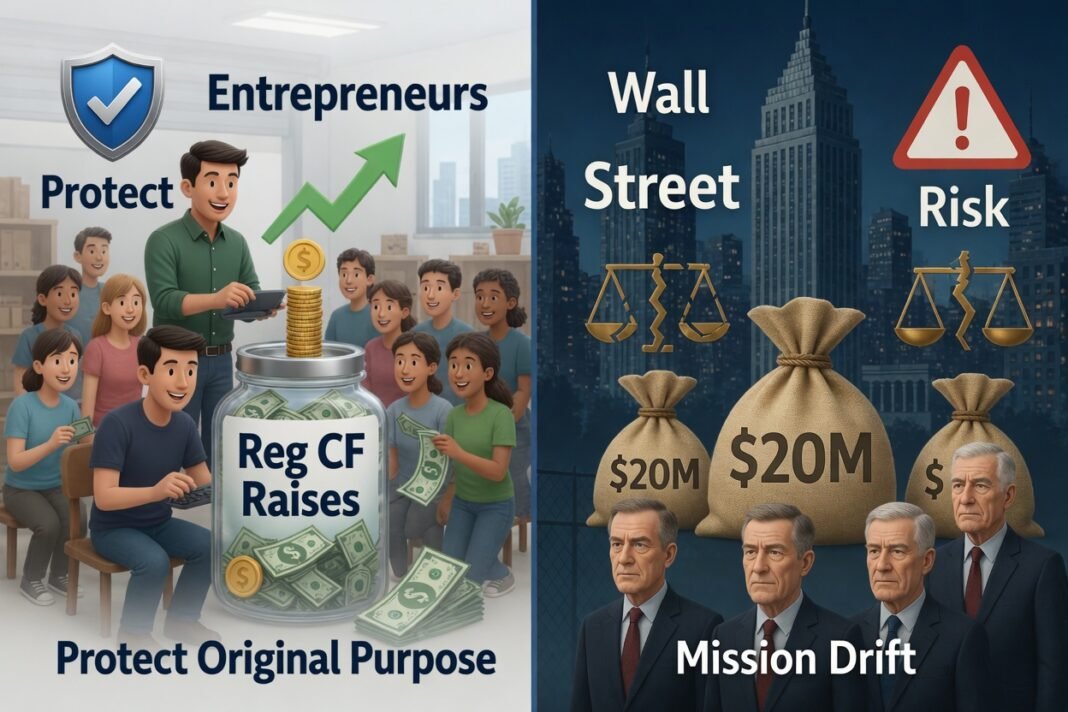
One of the biggest dangers facing crowdfunding today is mission drift.
Many participants are trying to turn crowdfunding into something it was never meant to be.
Bigger raises.
Larger issuers.
Institutional-style deals.
Wall Street economics with community branding.
But crowdfunding’s greatest strength was never transaction size.
Its strength was accessibility.
It gave founders without elite networks a chance.
It allowed communities to support innovation directly.
It opened doors traditional finance kept closed.
That’s what made it revolutionary.
Not Every Portal Needs to Survive
This may sound harsh, but every emerging industry experiences consolidation.
Some portals simply failed to build sustainable differentiation.
Many became little more than:
- white-label technology platforms,
- issuer listing sites,
- or marketing funnels wrapped in regulatory infrastructure.
That is not a sustainable moat.
The long-term winners will likely be portals that:
- build investor trust,
- cultivate strong communities,
- specialize by sector,
- provide meaningful value-added services,
- leverage AI and data intelligently,
- and develop true distribution advantages.
The answer to weak business models is not necessarily turning Reg CF into a quasi-public institutional market.
The Industry Should Focus on Quality and Not Just Scale
Instead of obsessing over larger caps, the industry should focus on:
- improving investor education,
- increasing transparency,
- strengthening due diligence,
- reducing fraud,
- improving issuer quality,
- and creating better long-term investor outcomes.
Because credibility matters more than fundraising volume.
If crowdfunding loses trust, it loses everything.
Final Thoughts
The irony is that the data already tells us where crowdfunding works best.
For nearly a decade, the overwhelming majority of Reg CF raises have remained under $1M, even after the cap increased to $5M.
That is the market naturally identifying the sweet spot of community-driven early-stage finance.
Trying to force Reg CF into becoming a $20M institutional-scale fundraising mechanism may help some portals survive in the short term.
But it also risks destroying the original identity, integrity, and purpose of crowdfunding itself.
And once that happens, the industry may discover too late that bigger was never actually better.