
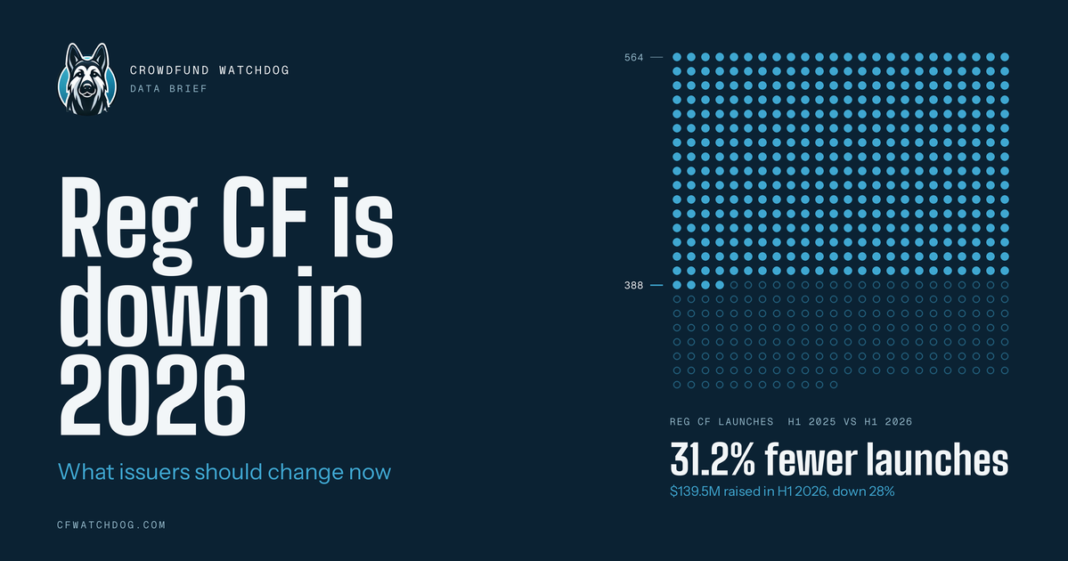

Regulation Crowdfunding raised $139.5 million in the first half of 2026. That is 28% less than the same period last year.
Let me say that again, because very few people in this industry seem keen to talk about it. Fewer companies are launching, fewer are raising, and the money that is still flowing is piling up in a small number of campaigns.
If you are an issuer planning a raise, this is not bad news to hide from. It is information to use. Here is what the numbers actually say, and what I would change before launching.
The Numbers, Plainly
According to Kingscrowd’s H1 2026 report:
- Reg CF raised $139.5 million, down 28.1% from H1 2025.
- Reg A+ raised $225.7 million, down 27.7%. Combined, that is $365.2 million.
- Reg CF launches fell to 388, from 564 a year earlier. That is a 31.2% drop.
- The median successful Reg CF raise was $147,500.
July did not help. Kingscrowd puts Reg CF at $22.89 million for the month, down 34.2% on July 2025, with a median raise of around $95,000.
So where did the money go? Crowdfund Insider points to competition from a resurgent IPO market, excitement around AI companies, crypto and newer prediction markets. In plain English, your investors now have far more places to put their money than they did two years ago, and some of those places are a lot noisier than a Reg CF campaign page.
A Tale of Two Markets
Here is where it gets interesting. 2025 was actually a strong year for the dollars. Reg CF raised $378.3 million, up 11%, even though offerings fell 29% to 1,006. Nine campaigns hit the $5 million cap and 101 crossed $1 million.
Fewer campaigns, more money. Kingscrowd called it quality over quantity, and 2026 is following the same script, only with less money overall.
Look at the concentration. In H1 2026 the top three platforms captured 71.0% of tracked volume and the top five captured 86.9%. In July, the top ten campaigns brought in about $11.47 million, nearly half of the positive Reg CF movement for the month.
The crowd has not gone away. It has become picky.
One more figure caught my eye. Kingscrowd counted 14,495 Reg CF investors in July, against 13,786 a year earlier, while the dollars fell 34.2%. My read is that people are still showing up, but they are writing smaller cheques. That is my interpretation, not a Kingscrowd finding, but it fits the picture.
What I Would Change Now
1. Build the audience before you build the campaign page
Crowdfunding campaign first, homework afterwards rarely works. I have been saying that for years and it has never been truer. With launches falling and money concentrating in the strongest campaigns, an issuer starting from zero simply gets lost.
Know who your first 100 investors are, by name, before you go live. If you cannot list them, you are not ready.
2. Set your target to your real capital need
Kingscrowd reports a 74.3% success rate for resolved Reg CF offerings in H1 2026 (396 of 533), up from 67.4% in 2025. Sounds great, doesn’t it? But Sherwood Neiss, one of the architects of Reg CF, has pointed out that a campaign can be labelled successful without meaningful validation. A company raising $10,000 against a real need of $500,000 is not a success story.
Investors are catching on. Pick the number your business actually needs, and be ready to defend it.
3. Plan around the median, not the headline
Nine campaigns hit $5 million in 2025. Half of the successful raises in H1 2026 were under $147,500. Which of those two numbers looks more like your company?
If your plan needs seven figures, you will need an anchor: a lead investor, a proven community, or real revenue. If you do not have one, consider a smaller first round, or look at Reg A+, where the median successful raise in H1 2026 was $8.2 million (from just nine closes). Just remember that Reg A+ comes with heavier legal work and SEC qualification, so it is not a shortcut.
4. Pick your platform on investor fit, not brand alone
Crowdfund Insider’s H1 2026 deal flow list has Wefunder at $39.4 million, DealMaker Securities at $27.5 million, StartEngine at $24.3 million, Equifund at about $11.5 million and Republic at about $9.7 million. There are around 73 FINRA-registered funding portals, yet only one new portal launched in the first half.
The big names see most of the traffic, but that does not mean the biggest platform is right for you. Ask each one for real results from campaigns in your sector, how many investors they realistically expect to bring, and what it will cost. If the answers are fluffy, that is your answer.
5. Answer the question your investor is silently asking
Why should I put money in your company instead of an IPO, an AI stock or crypto?
Show traction. Show revenue. Explain the path to liquidity in plain English, and be honest that there may not be one for years. Kingscrowd’s mid-year report found 15 failures and 11 exits through August 3, 2026, and eight of those 11 exits were IPOs or direct listings. It also noted that BOXABL’s SPAC merger showed how messy converting crowdfunded shares into tradable stock can be, with delays and restricted share mechanics for investors.
Investors have been burned by hype before. Do not add to the pile.
6. Treat your investors like customers after the raise
The raise is not the finish line. It is the start of a relationship with hundreds or thousands of people who now own a piece of what you are building. Update them regularly, file your annual report on time, and share bad news early. Nothing destroys trust faster than silence.
A business focused on the wrong customer will be short lived. For an issuer, the customer is now your investor.
Watch the INVEST Act, But Do Not Plan Around It
The House passed the INVEST Act (H.R. 3383) by 302 votes to 123, and it went on to the Senate. For Reg CF, the change I can confirm is a higher threshold for independent accountant review of financial statements, from $100,000 to $250,000, with the SEC given discretion to go up to $400,000. If it becomes law, smaller raises could get cheaper and simpler. Until it does, plan on today’s rules.
Is Reg CF dying? No. Is it getting harder for the unprepared? Absolutely.
The small guy can still win, but not by launching a page and hoping. The issuers who will do well in this market are the ones who arrive with an audience, a realistic target, an honest pitch and a plan for looking after their investors afterwards.
Thinking about a raise? Head over to Smart Crowdfunding to learn more.
If you spot a campaign that does not look right, use the Report a Scam button at the top right of this page.
This article is for information and opinion only and is not legal, financial or investment advice. Figures are taken from the sources below and were accurate at the time of writing.
Sources
- H1 2026 Investment Crowdfunding, Kingscrowd (21 July 2026)
- A Selective Crowdfunding Market Still Found Its Winners: July 2026, Kingscrowd
- Mid-Year 2026 Exit and Failure Report, Kingscrowd
- 2025 Investment Crowdfunding Annual Report, Kingscrowd
- Reg CF: FINRA Regulated Funding Portals Hover Around 70, Crowdfund Insider (23 Sept 2026)
- US Equity Crowdfunding in 2026, LenderKit
- House Passes the INVEST Act, Harvard Law School Forum on Corporate Governance