

A Crowdfund Watchdog Investigation
For more than a decade, accredited investor verification providers have played a critical role in the crowdfunding and private capital markets ecosystem.
Founders relied on them to satisfy Rule 506(c) requirements. Investors trusted them with highly sensitive financial information. Their role was widely viewed as neutral compliance infrastructure – a necessary but largely invisible part of the fundraising process.
Recently, however, Crowdfund Watchdog reviewed communications that raise an important question for the crowdfunding industry:
When does investor verification become investor marketing?
The VerifyInvestor Case
VerifyInvestor built its reputation as one of the most recognized accredited investor verification providers in the United States.
The company’s public messaging emphasizes security, privacy, confidentiality, and investor protection. Investors are encouraged to submit highly sensitive financial information, including tax returns, bank statements, brokerage statements, CPA letters, and other documentation necessary to verify accredited investor status.
Many founders have paid VerifyInvestor specifically to provide this compliance service to their investors.
Many investors have used VerifyInvestor believing they were participating in a verification process required by securities regulations.
That is why recent communications sent to verified investors deserve attention.
Crowdfund Watchdog reviewed an email distributed to accredited investors promoting an unrelated investment opportunity available through the broader tZERO ecosystem, VerifyInvestor’s parent company.
The email was not related to the original issuer for whom the investor was verified.
Instead, it promoted a completely separate investment opportunity.
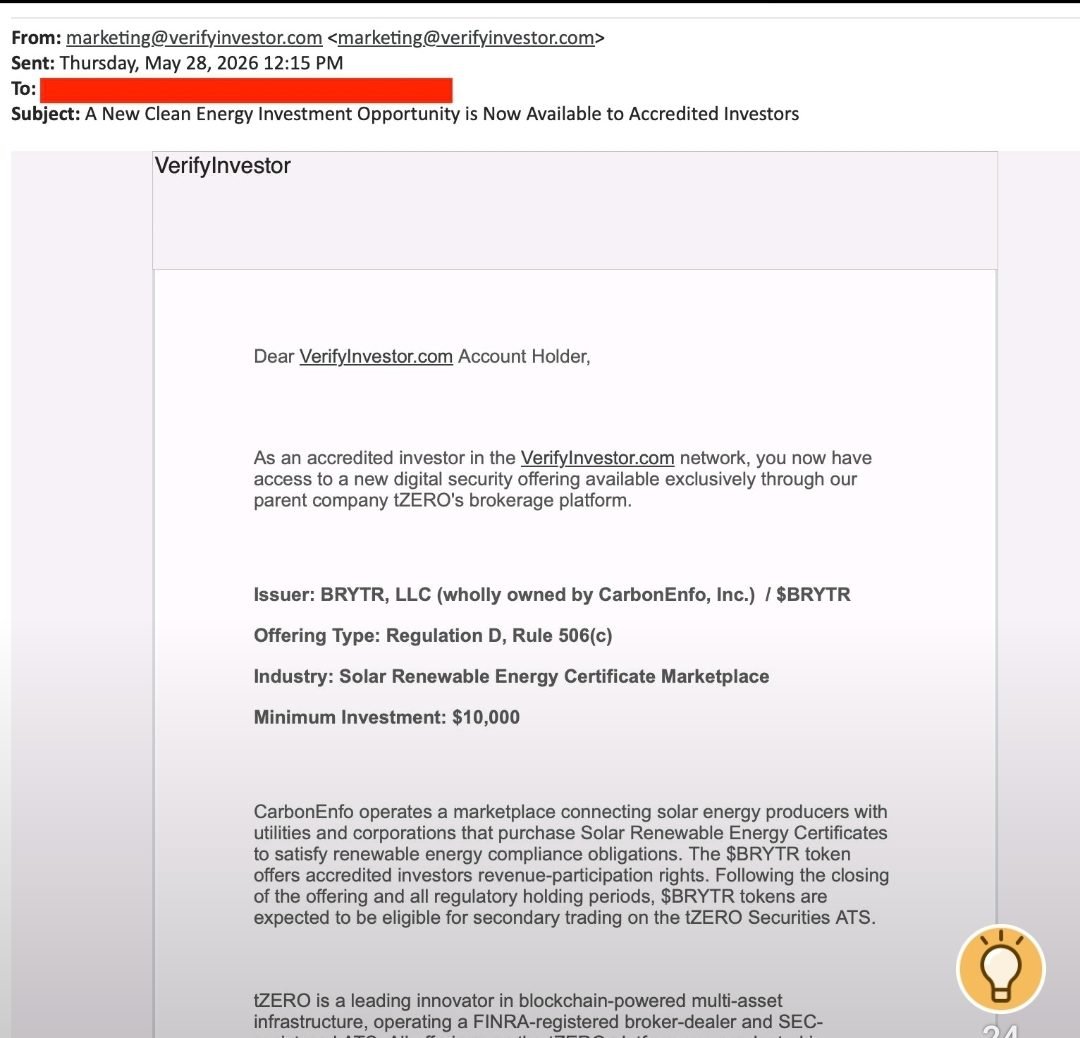
The obvious question becomes:
Would investors reasonably expect this outcome when submitting financial documents for accreditation verification?
The Trust Relationship
This issue is not primarily about legality.
It is about trust.
Verification providers occupy a unique position within the private capital markets.
Unlike marketing companies, lead generation firms, or investment newsletters, verification providers receive information because investors are attempting to comply with securities regulations.
That distinction matters.
Investors are not simply providing an email address.
They are often providing some of the most sensitive financial information they possess.
When a company positions itself as a confidential verification service, investors naturally develop expectations regarding how that relationship will be used in the future.
The crowdfunding industry depends heavily on trust, and trust is built not only through legal disclosures but also through reasonable expectations.
The Transparency Question
To be clear, Crowdfund Watchdog has found no evidence that VerifyInvestor violated any law, regulation, privacy policy, or contractual obligation.
Publicly available privacy disclosures associated with the broader tZERO ecosystem contemplate certain forms of affiliate marketing and information sharing.
That is not the issue.
The issue is whether investors and founders clearly understood the broader implications of the relationship they were entering.
Many founders have historically viewed VerifyInvestor as a neutral third-party compliance provider.
Many investors likely viewed VerifyInvestor as a verification service rather than a participant in investment distribution.
Whether those perceptions remain accurate is a question worth asking.
Why Founders Should Pay Attention
Founders spend enormous amounts of time, money, and effort building investor relationships.
When founders engage a verification provider, they generally believe they are purchasing compliance services – not helping build a third party’s investor network.
As verification providers become more integrated with broker-dealers, investment platforms, and capital formation ecosystems, founders should understand how those relationships may evolve over time.
Transparency benefits everyone involved.
Why Investors Should Pay Attention
Investors should carefully review the privacy policies, terms of service, marketing preferences, and affiliate relationships associated with any platform that requests sensitive financial information.
Before uploading documentation, investors should understand:
- Who is collecting the information.
- Why the information is being collected.
- How long it will be retained.
- Whether marketing communications may follow.
- Whether affiliate companies may contact them.
- What opt-out rights are available.
These questions are increasingly important as private market infrastructure providers expand beyond their original functions.
The Bigger Industry Conversation
The VerifyInvestor situation may ultimately represent a broader trend occurring throughout private capital markets.
As crowdfunding, private placements, tokenized securities, and alternative investments continue to converge, companies are building integrated ecosystems that combine:
- Investor verification
- Identity management
- KYC and AML compliance
- Broker-dealer services
- Investor onboarding
- Investment marketplaces
- Capital formation
From a business perspective, this evolution makes sense.
From a transparency perspective, however, it raises important questions.
When investors submit information for compliance purposes, do they fully understand the broader ecosystem they are entering?
When founders engage verification providers, do they understand how investor relationships may be utilized across affiliated platforms?
These are questions the industry should be discussing openly.
Crowdfund Watchdog’s Position
This article is not an allegation of wrongdoing.
It is a call for transparency.
The crowdfunding industry has worked hard to build trust among founders, investors, platforms, and service providers.
As the industry evolves, that trust must remain a priority.
Investors deserve clarity.
Founders deserve clarity.
And whenever a compliance relationship begins to overlap with a marketing relationship, the industry benefits from asking questions—even when the answers may ultimately prove that everything is being done within the rules.
Sometimes the most important investigations are not about what is illegal.
They are about what investors and founders reasonably expect.
About to launch a fundraise? Considering an investment?
Check out our Crowdfund Forensics Due Diligence Services
Blunt, forensic-grade analysis for investors.
Every week, retail investors lose money to overhyped campaigns, inflated valuations, and founders who shouldn’t be anywhere near a raise.
We cut through the noise with professional, independent due diligence reports designed to protect your capital.
No hype. No sugar-coating. No conflicts of interest.