
The SEC’s New 506(c) Guidance: Is Self-Certification Making a Comeback?
For years, one of the biggest frustrations surrounding Regulation D offerings, particularly Rule 506(c), has been accredited investor verification.
Investors have complained about handing over tax returns, bank statements, and other sensitive financial documents. Issuers have faced increased costs and friction during fundraising. Entire businesses have emerged to provide third-party verification services to bridge the gap.
Now, a recent SEC staff no-action letter may have changed the landscape.
While this is not a new law or a court ruling, many securities attorneys are describing it as one of the most significant developments in private capital raising in recent years.
The question being asked throughout the industry is simple:
Has self-certification made a comeback?
Understanding the Difference Between 506(b) and 506(c)
Under Rule 506(b), issuers have traditionally been able to rely on investor representations regarding accredited status, provided they have no reason to believe those representations are false.
Rule 506(c), however, has always been different.
Because 506(c) permits general solicitation and public advertising, issuers must take “reasonable steps to verify” that every purchaser is an accredited investor.
In practice, this often meant requiring:
- Tax returns
- Bank statements
- Brokerage account records
- Letters from attorneys, CPAs, or financial advisers
- Third-party verification services
Although designed to protect investors and maintain market integrity, many argued that the process created unnecessary friction and discouraged participation in private offerings.
The Latham & Watkins No-Action Letter
In March 2025, the SEC’s Division of Corporation Finance issued a no-action letter in response to a request from Latham & Watkins LLP.
The letter outlined circumstances under which an issuer could satisfy the verification requirements of Rule 506(c) without obtaining traditional financial documentation from investors.
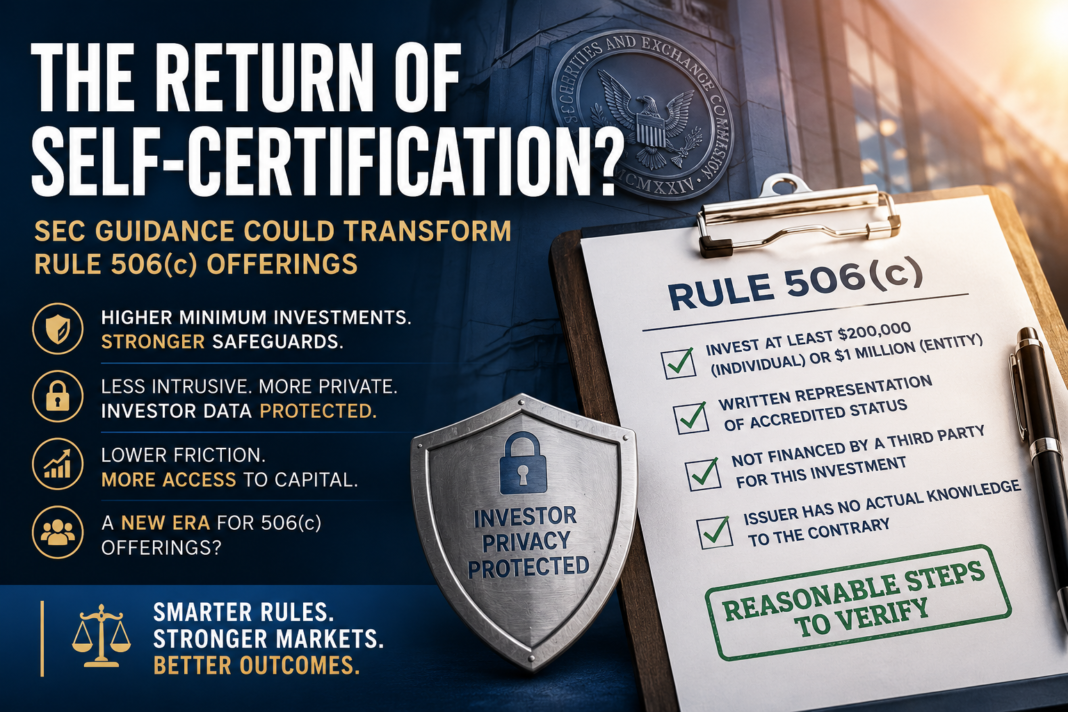
According to the SEC staff, reasonable verification steps may be met if:
- An individual invests at least $200,000;
- An entity invests at least $1 million;
- The investor provides written confirmation that they are accredited;
- The investor confirms that the investment is not being financed by a third party specifically to satisfy the minimum investment requirement; and
- The issuer has no actual knowledge that would suggest the investor is not accredited.
For many legal practitioners, this effectively creates a practical framework that resembles self-certification—albeit with important safeguards attached.
What This Means for Investors
From an investor perspective, the implications are significant.
Privacy concerns have long been a sticking point in private markets. Many high-net-worth individuals are understandably reluctant to provide extensive personal financial information simply to participate in an investment opportunity.
Under this new framework, investors meeting the minimum investment thresholds may no longer need to disclose the same level of sensitive documentation, reducing both inconvenience and privacy risks.
This could encourage broader participation in Rule 506(c) offerings and make the investment process considerably more efficient.
What This Means for Issuers
For issuers, the benefits are equally obvious.
The traditional verification process often creates delays during fundraising campaigns, increases legal and compliance costs, and introduces additional administrative burdens.
Reducing that friction could:
- Accelerate capital raises;
- Lower compliance expenses;
- Improve investor conversion rates;
- Make publicly marketed 506(c) offerings more attractive than ever before.
At a time when startups are competing for capital in increasingly challenging markets, removing unnecessary barriers could provide a meaningful advantage.
The Impact on Third-Party Verification Providers
Perhaps the most interesting question concerns the future role of third-party accreditation services.
Over the past decade, investor verification businesses have become an established part of the private fundraising ecosystem. Many issuers adopted these services to satisfy the SEC’s reasonable verification requirements while avoiding direct handling of sensitive investor information.
If large minimum investments combined with written representations become the accepted market standard, some issuers may conclude that external verification services are no longer necessary for certain offerings.
That does not mean these businesses disappear overnight.
Smaller investments, more complex ownership structures, institutional requirements, and risk management considerations will continue to create demand for independent verification solutions.
Nevertheless, the economics and value proposition of the industry could evolve significantly in the years ahead.
An Important Limitation
It is crucial to understand what this development actually is, and what it is not.
The SEC staff’s position is contained within a no-action letter.
That means:
- It is not a new SEC rule;
- It is not legislation passed by Congress;
- It is not a judicial precedent;
- It applies specifically to the facts presented in the request.
Issuers remain responsible for taking reasonable steps to verify accredited status and must still exercise judgment when relying upon investor representations.
The presence of contrary information or circumstances could still undermine reliance on these standards.
A Turning Point for Private Capital Markets?
Whether this ultimately proves to be a watershed moment remains to be seen.
However, the direction of travel appears increasingly clear.
The private capital markets have grown dramatically over the past decade, and regulators continue to face pressure to modernise rules that many market participants consider outdated or unnecessarily burdensome.
The SEC staff’s latest guidance reflects an acknowledgment that substantial investment commitments, combined with written representations and the absence of red flags, may provide sufficient confidence that investors meet accredited standards.
For founders, investors, and crowdfunding professionals alike, this development is worth watching closely.
It may not represent a complete return to self-certification, but it is arguably the closest the industry has come since Rule 506(c) was introduced.
And for many participants in the private capital ecosystem, that could be a very welcome change.
My Personal View
I believe the SEC’s latest guidance strikes a sensible balance between investor protection, privacy, and access to capital.
Investor verification exists for good reason. Protecting investors and maintaining the integrity of private markets should always remain a priority, and some degree of scrutiny is both necessary and appropriate. Requiring written representations alongside substantial minimum investment amounts appears to be a reasonable trade-off that preserves safeguards without creating unnecessary friction.
At the same time, the industry must recognise growing concerns about the amount of sensitive personal information investors are expected to hand over to third parties. Tax returns, bank statements, and other financial records represent some of the most private data an individual possesses. Reducing the need for excessive data collection is a positive development, particularly in an age where cybersecurity and data misuse remain constant concerns.
This evolution may also reduce dependence on verification businesses whose models rely heavily on collecting and storing investor information. Independent verification will undoubtedly continue to play an important role in certain circumstances, but investors should not be forced into unnecessarily intrusive processes when alternative safeguards can achieve the same regulatory objective.
It is also worth noting that the United Kingdom has operated with self-certification mechanisms for many years. Under UK financial promotion rules, high-net-worth individuals and self-certified sophisticated investors have long been able to certify their own eligibility to participate in certain investment opportunities. While no system is perfect, the framework has generally functioned effectively and demonstrates that self-certification, when supported by appropriate legal safeguards and clear responsibilities, can work in practice.
That said, wealth itself should never be confused with investment sophistication. A person’s net worth or income does not automatically make them a knowledgeable investor, just as individuals of more modest means may possess significant expertise and experience. The accredited investor framework remains an imperfect proxy for determining who truly understands investment risk.
Ultimately, the challenge for regulators is to balance three competing priorities: privacy, access, and protection. The SEC’s latest position appears to move closer to that equilibrium rather than favoring one objective at the expense of the others.
Looking ahead, I believe this approach will become the de facto standard for many Rule 506(c) offerings. If that happens, the industry may finally move toward a verification model that is less intrusive, more efficient, and better aligned with the realities of modern private capital markets.
About the Author
Shane Liddell is the founder of Smart Crowdfunding and has advised more than 3,000 founders on equity crowdfunding raises across Reg CF, Reg D 506(c), and Reg A+ over the past 14 years. Smart Crowdfunding provides end-to-end campaign strategy, investor marketing, and founder coaching for companies raising capital through SEC-exempt offerings.