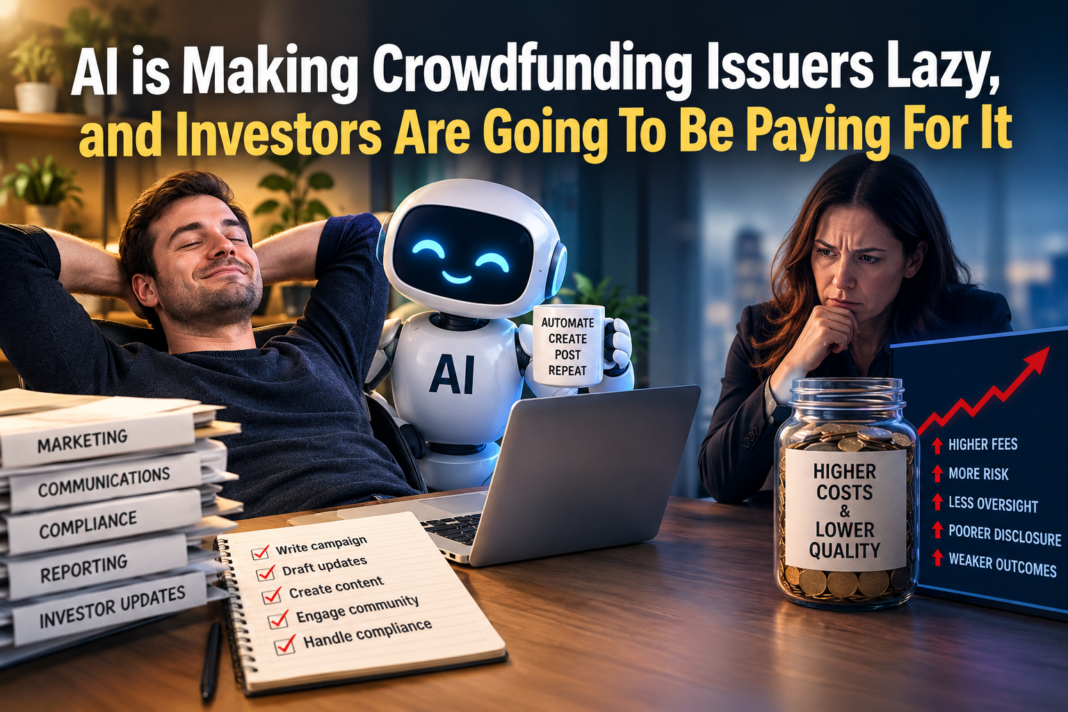

Crowdfunding has always rewarded a good story. A compelling pitch, a polished presentation and a confident founder video can make all the difference between a campaign that attracts investors and one that struggles to get noticed.
But generative AI has changed the game.
Today, a founder with little traction, limited operational experience or a poor understanding of their own financials can produce fundraising materials that look just as professional as those of an established business. A few prompts, a little editing and, hey presto, the frog becomes a prince!
There is just one problem. The business hasn’t changed. The founder hasn’t necessarily become any more capable, either. All that may have changed is the way the opportunity is presented.
And that is where things start to get interesting.
The Good: AI Can Make Fundraising Better
Let’s be clear. AI has some very real benefits for crowdfunding.
Founders can use it to improve their pitch, work on financial models, create visuals, personalise investor outreach and identify the types of investors who might be interested in their business. Platforms can use it to flag suspicious patterns, identify potential risks and match campaigns with likely investors.
For legitimate businesses, this is good news. Anything that reduces the cost of putting together a fundraising campaign and gives founders more time to focus on building their business has to be worth considering.
But there is a big difference between using AI to help you run your business and using it to create the impression that you know what you’re doing.
Unfortunately, the two are becoming increasingly difficult to distinguish.
When the Presentation Becomes Better Than the Business
AI doesn’t require a founder to have the experience or knowledge that its output appears to demonstrate.
It can write a convincing go-to-market strategy for someone who has never sold into that market. It can produce financial projections that look impressive, even when the underlying assumptions are questionable. It can generate product images, explainer videos and synthetic customer testimonials that a retail investor may struggle to distinguish from genuine evidence.
In equity crowdfunding, this creates a particular problem.
Many retail investors make their initial assessment based largely on the campaign page. They don’t have the time, resources or access to conduct the sort of detailed due diligence that a professional investor might undertake.
So what happens when the campaign looks excellent but the business behind it is nowhere near as impressive?
The gap between presentation and reality grows wider.
Worse still, a founder who relies on AI to do most of the thinking may never develop the detailed understanding that their own fundraising materials suggest they possess.
The pitch improves. The business doesn’t.
Compliance: Looking the Part Isn’t the Same as Being Prepared
Compliance is a good example of where this can go wrong.
AI can now help founders draft offering documents, risk disclosures, Form C filings and other fundraising paperwork. The resulting documents may look complete, well organised and professionally written.
They may even make it through an initial platform review or legal review.
But here’s the question: does the founder actually understand what they’ve put their name to?
Can they explain the risks disclosed in their offering documents? Do they understand the assumptions behind their financial projections? Can they explain the security they’re offering investors and why the chosen regulatory exemption applies to their particular circumstances?
Or do the answers become vague and circular the moment someone asks a question that isn’t covered by the script?
There is a world of difference between having professionally prepared documentation and understanding the obligations you’re taking on.
In a securities offering, that difference matters. A founder who cannot explain their own disclosures should raise questions about how well prepared they are to run the business, let alone manage the responsibilities that come with raising money from investors.
For investors, this should be a warning sign. If a founder cannot confidently explain the fundamentals of their own offering, why would you hand over your money?
The Problem Goes Beyond Compliance
The same issue applies to market research, competitive analysis and operational planning.
AI can produce a pitch deck that sounds authoritative. It can explain the market opportunity, identify competitors and present a seemingly logical plan for growth.
But ask the founder why they chose a particular financial assumption, what they would do if their main sales channel failed to deliver, or what they learned from an earlier attempt to build a similar business, and the answers may tell a very different story.
The materials are polished. The founder’s understanding isn’t.
I’ve always believed that investors need to look beyond the pitch and examine the people behind it. That becomes even more important when technology makes it easier than ever to produce a convincing story.
A good presentation is useful. A founder who understands their business is essential.
Confusing the two is a mistake investors can ill afford to make.
The Good, the Bad and the Ugly of AI-Generated Campaigns
Research has already suggested that even relatively modest AI-assisted changes to crowdfunding campaign narratives can improve predicted success rates. At the same time, research into reward-based crowdfunding has found that campaigns disclosing heavy AI use can face a trust penalty.
There is an obvious tension here.
AI can make a campaign more persuasive, but investors may also question how much of what they’re seeing is genuine.
Historically, poor writing, inconsistent figures and amateurish presentation could provide clues about the quality of a campaign. They were never reliable indicators on their own, of course, but they could prompt further questions.
Those signals are becoming less useful.
A polished deck no longer tells us much about the person who created it. It could be the work of an experienced founder who understands every detail, or someone who has spent an afternoon prompting a language model.
The result? Looking professional is becoming cheaper, while establishing whether a business deserves investment remains just as difficult.
And that brings us to the next problem.
The AI Arms Race
Founders and the agencies supporting them can use AI to optimise almost every aspect of a fundraising campaign. Pitch language can be refined for better conversion. Visuals can be made to look production-ready. Financial narratives can be made more convincing. Compliance documents can be polished, and content calendars can create the appearance of constant activity and momentum.
Meanwhile, investors, platforms and independent reviewers can use AI to scrutinise those same campaigns.
Their tools can compare statements across documents, check claimed traction against public information, assess financial assumptions against industry benchmarks and flag patterns associated with previous failed campaigns.
There are already tools capable of carrying out rapid, forensic-style reviews of equity crowdfunding disclosures. More will inevitably follow.
So who wins?
Neither side has a permanent advantage.
A well-configured AI system can help a founder produce materials that pass many automated checks, particularly when the claims aren’t outright fabrications but are instead overly optimistic, incomplete or presented without sufficient context.
An investor’s AI can make the opposite mistake, missing something important that an experienced human reviewer would recognise immediately.
This is why human judgement still matters. The real test isn’t simply whether the documents appear consistent. It’s whether the founder can explain and defend them without having to read from a script.
For retail investors, the problem is straightforward: the cost of looking sophisticated has fallen dramatically, but the cost of verifying the claims hasn’t fallen nearly as quickly.
What About the Crowdfunding Platforms?
Platforms sit right in the middle of this problem.
A professional-looking campaign that raises money generates fees and creates positive headlines. A campaign that later reveals an unprepared founder, unrealistic operating plans or a poor understanding of compliance can create serious reputational and regulatory problems.
Unfortunately, those problems may not become apparent until after investors have committed their money.
This is where independent investigators and investor-watchdog initiatives have an important role to play. By examining disclosures, checking founder track records and challenging claims, they can help identify problems that a polished campaign page might otherwise conceal.
Their work becomes more valuable as the cost of producing convincing fundraising materials continues to fall.
Of course, platforms cannot reasonably be expected to identify every problem before a campaign launches. But there is a strong argument for looking beyond presentation and asking more searching questions about the people and businesses seeking investment.
After all, a successful fundraising campaign isn’t necessarily the same thing as a successful business.
The Regulators Can’t Do All the Heavy Lifting
None of this changes the underlying rules.
Misleading statements in a securities offering don’t become acceptable simply because they were generated by AI rather than written by a human being.
But enforcement takes time, while fundraising campaigns can launch, reach their targets and close in a matter of weeks.
Most equity crowdfunding raises will never be subject to an SEC examination. That means the practical protection available to many retail investors depends heavily on what platforms, reviewers and investors themselves are prepared to scrutinise before the money changes hands.
And that brings us back to the founder.
Does the person running the company understand the financial projections, the risks, the business model and the obligations they’ve described to investors?
Or have they simply produced a set of documents that looks as though they do?
That is a question worth asking before investing, not after something goes wrong.
What Should Investors Look For?
Investors need to stop treating polished fundraising materials as evidence of a good investment.
A professional pitch deck should be the starting point for an assessment, not the conclusion.
Instead, look for evidence that is harder to manufacture.
- Customers and traction. Can claimed customer relationships, contracts, revenue or usage figures be independently verified?
- Founder track record. What have the founders built before? How did those businesses perform? Are there previous companies, failures or relevant litigation that deserve closer examination?
- Technical credibility. Have important product claims been tested or reviewed by someone independent of the campaign?
- Financial understanding. Can the founder explain the assumptions behind the projections and what would happen if things don’t go according to plan?
- Compliance knowledge. Does the founder understand the offering, its risks and the obligations they are taking on?
- Straight answers. When asked difficult questions, does the founder answer directly, or do they hide behind rehearsed language and carefully prepared documents?
AI tools can help investors conduct these checks. They can identify inconsistencies, find information and highlight areas that deserve further investigation.
But they cannot replace judgement. Sometimes the most important warning sign isn’t a discrepancy in a spreadsheet. It’s the realisation that the person presenting the opportunity doesn’t appear to understand it.
And What About Founders?
For founders who genuinely know their business and intend to execute their plans, AI presents a tremendous opportunity.
When almost anyone can produce a competent-looking campaign, the businesses that can demonstrate real progress have an opportunity to stand out.
Customers, revenue, a product that has actually shipped and measurable traction become increasingly important. So does the ability to discuss those achievements in detail.
AI can help a founder communicate more clearly, improve their materials and keep documentation organised. It can save time and reduce costs.
What it cannot do is manufacture genuine commercial progress.
Nor can it replace the founder’s own understanding of their business or their legal responsibilities.
Founders who rely too heavily on generated content while lacking verifiable milestones and the ability to defend their own claims risk damaging investor confidence. They may also be setting themselves up for operational problems once the money has been raised.
Raising capital is one thing. Delivering on the promises that persuaded people to invest is another.
We Don’t Need to Ban AI. We Need to Get Smarter About It.
The answer isn’t to ban AI from crowdfunding. That would be both impractical and unnecessary.
Instead, platforms should consider requiring clearer evidence to support important campaign claims and doing more to test whether founders understand the businesses and offerings they are presenting.
Independent review services can help investors examine disclosures and identify potential warning signs. Investors themselves need to become more sceptical of presentation and more demanding when it comes to evidence.
And founders need to understand the difference between using AI as a tool and using it as a substitute for competence.
Those who use it to communicate genuine progress more effectively will benefit. Those who use it to make an unprepared business look investment-ready may find that the same technology helps others expose the weaknesses they hoped to conceal.
The Bottom Line
Crowdfunding has always had its share of serious businesses and speculative stories. AI makes it easier to present both in a convincing way.
The danger is that the people behind those stories may be less prepared than ever to answer the questions that really matter.
When investors put money into a company because its fundraising materials look excellent, only to discover that the founders cannot explain or deliver on what they’ve presented, the consequences go beyond individual losses. Confidence in the entire crowdfunding industry suffers.
But there is another side to this.
Businesses that use AI to communicate genuine progress, support their claims with evidence and help investors understand what they’re backing can benefit enormously. The technology can make good businesses better at telling their stories without taking away the need for founders to understand those stories themselves.
The challenge is knowing which type of business you’re looking at.
That has become harder to judge from the campaign page alone, and more important than ever to get right.
AI can make a frog look like a prince. It cannot guarantee that the prince knows how to run a business.
And for investors, that is the difference that matters.