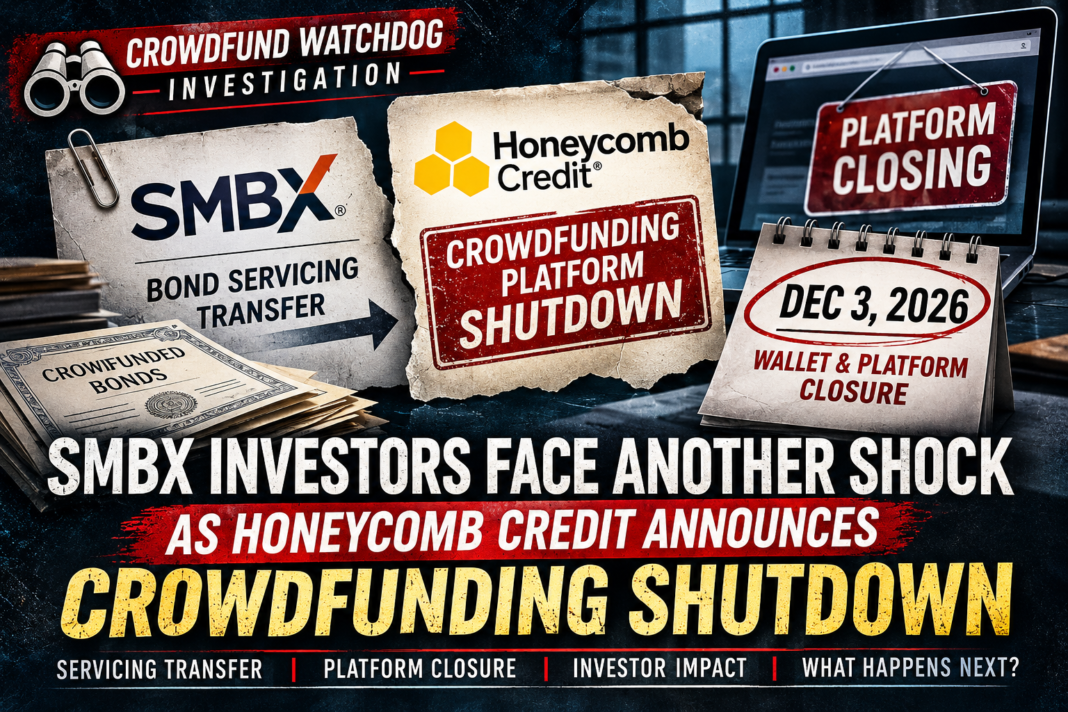

After SMBX transferred bond servicing responsibilities to Honeycomb Credit, Honeycomb has announced that it is winding down its own investment crowdfunding platform. The developments raise serious questions about investor protection, communication, and the long-term servicing of crowdfunded debt.
For investors who supported small businesses through Regulation Crowdfunding (Reg CF), the past few months have brought an unwelcome series of developments.
First, SMBX announced plans to transition the servicing of outstanding small-business bonds to Honeycomb Credit, subject to issuer participation.
Now, just months later, Honeycomb Credit has announced that it is winding down its investment crowdfunding platform.
The timing raises an obvious question:
What happens when the platform responsible for managing crowdfunding investments decides it can no longer operate that business?
For investors holding bonds that may not mature for several years, this is more than an administrative inconvenience. It raises questions about future repayments, account records, communication, and who will remain responsible for servicing their investments.
1. The SMBX transition: The first warning sign
In September 2026, SMBX investors began discussing an email announcing that servicing responsibilities for outstanding SMBX bonds would transition to Honeycomb Credit for issuers that elected to participate.
According to the email reproduced by an investor, SMBX had reached an agreement with Honeycomb to assume administrative servicing responsibilities.
The communication also identified Wells Fargo’s Philanthropy & Community Impact Team as providing financial support for the transition costs.
That detail is significant.
The involvement of an outside financial institution in subsidizing the transition suggests the transfer required additional resources. It does not, by itself, establish that either platform was insolvent or unable to meet its obligations.
Investors nevertheless reported uncertainty about the process, particularly what would happen if an issuer did not participate in the transition. Reddit
2. November 13: Honeycomb announces its own shutdown
On November 13, 2026, Honeycomb notified investors that it would stop facilitating new investment crowdfunding offerings.
Its official FAQ confirms that the investment crowdfunding platform is winding down and that the Honeycomb Wallet will close on December 3, 2026.
Key dates
Nov 13 2026
Shutdown notice issued
Honeycomb informs investors it will no longer facilitate new crowdfunding offerings.
Dec 3 2026
Wallet and platform closure
Investors must check their bank details before 4 p.m. Eastern Time. Honeycomb plans to transfer wallet balances to bank accounts.
Honeycomb’s FAQ says existing borrowers must continue to make payments and directs them to LoanPro for loan management. Its public statement does not say that outstanding loans are automatically cancelled or that investors have lost their investments. Honeycomb Credit+1
That distinction is essential. A platform shutting down does not automatically mean the underlying investment has failed.
But it does create a new set of risks and practical problems for investors.
3. Investor complaints: Missing balances and delayed transfers
The most concerning reports involve investors who say their available funds did not appear correctly after the SMBX-to-Honeycomb transition.
In an October 19 Reddit discussion, one investor reported having approximately $1,800 available for withdrawal before the transition, only to see a zero available balance on Honeycomb.
The investor subsequently posted what they described as a response from Honeycomb, explaining that SMBX escrow funds were still being transferred and that the process could take several weeks.
By November 14, the investor reported that the issue remained unresolved. Reddit
These are unverified investor accounts. Crowdfund Watchdog has not independently reviewed the investor’s statements, account records, escrow statements, or correspondence.
Nevertheless, the reports identify an important issue that deserves investigation:
Can every dollar held for SMBX investors before the transition be traced, reconciled, and made available to its rightful owner?
A delayed transfer does not establish that money is missing. But investors should not have to guess where their funds are or when they can access them.
4. Honeycomb’s explanation: Crowdfunding is no longer viable
In the November 13 email reproduced by investors, Honeycomb CEO Mathias Jamora attributed the decision to falling investor participation and rising operating costs.
The email states that nationwide crowdfunding investor participation had fallen by more than half from its 2021 peak. It also says Honeycomb investors had provided more than $50 million to over 500 small businesses and renewable energy companies during the preceding decade. Reddit
Those figures are Honeycomb’s own statements and have not been independently verified for this article.
The explanation raises a broader industry concern.
Crowdfunding platforms collect fees while investments are originated, but debt securities can remain outstanding for years after the original fundraising campaign closes.
What happens when the revenue from new offerings is no longer sufficient to support the ongoing costs of servicing older investments?
This is a structural risk that deserves far more attention across the Regulation Crowdfunding industry.
5. A second problem: Investors lose their online portfolio access
Honeycomb’s official FAQ confirms that investors will lose access to their online portfolio dashboard after December 3.
Going forward, investors are expected to receive monthly statements by email. Historical records will be available through requests rather than direct dashboard access.
Honeycomb also states that it expects to continue facilitating repayments for the life of loans that remain under its servicing arrangements. Some businesses may instead choose to administer repayments themselves. Honeycomb Credit
This raises practical concerns.
Investors may hold multiple investments with different payment schedules, interest rates, maturities, and repayment histories.
Removing direct access to those records creates additional work for investors, especially if a loan becomes delinquent or there is a dispute about payments.
Crowdfund Watchdog believes investors should retain reliable access to complete investment records throughout the life of their securities, even after a platform stops originating new offerings.
6. The regulatory question: Who protects investors when a funding portal closes?
Regulation Crowdfunding was designed to help smaller businesses raise capital while providing a framework for investor protection.
But the SMBX and Honeycomb situation highlights an important distinction.
A crowdfunding intermediary can facilitate an offering without becoming the party legally responsible for repaying investors.
In SMBX’s case, the transition notice says the underlying issuer remains responsible for its bond obligations.
That means an investor’s legal claim generally remains against the business that issued the bond, subject to the specific investment documents.
The problem is that investors may depend on the intermediary or its servicing partner for payment administration, records, and communications.
If that service becomes disrupted, the underlying legal rights may remain intact while exercising those rights becomes much more difficult.
The industry needs a credible answer to a simple question: Who maintains the system when the platform is gone?
7. Questions SMBX and Honeycomb should answer
Crowdfund Watchdog believes both companies should provide clear, written answers to the following questions:
- How many outstanding SMBX bonds were successfully transferred to Honeycomb for servicing, and how many were not?
- What is the total value of investor funds still being transferred or reconciled from SMBX?
- Have all outstanding investor wallet balances been reconciled against the relevant escrow and payment processor records?
- When did Honeycomb first determine that its crowdfunding platform was no longer financially viable, and was that before or after it agreed to the SMBX servicing transition?
- What arrangements and financial resources will support ongoing loan servicing after December 3?
- Who will maintain investor records, payment histories, and servicing responsibilities if Honeycomb later stops providing those services?
- What specific steps will be taken to assist investors who report missing balances, delayed withdrawals, or incomplete investment records?
The timing of the SMBX transition and Honeycomb’s subsequent announcement makes question four especially important. It does not establish that Honeycomb knew a shutdown was inevitable when the transfer was arranged.
8. What investors should do immediately
Investor protection checklist
Deadline: Dec 3
✔ Check and update your linked bank account before 4 p.m. ET on December 3.
✔ Download your full investment portfolio, payment history, and upcoming payment schedule.
✔ Save all SMBX bond certificates, prospectuses, and transfer notices.
✔ Compare your old SMBX balances with your Honeycomb records.
✔ Keep copies of emails and report any balance differences in writing.
✔ Confirm who will service each outstanding bond or loan.
Honeycomb’s official investor FAQ provides instructions for withdrawing funds, exporting records, and requesting assistance.
9. Crowdfund Watchdog’s position
The SMBX and Honeycomb situation should serve as a warning to the entire crowdfunding industry.
It is not enough for platforms to help businesses raise money.
They must also have credible plans for what happens to investors after the fundraising campaign ends—and what happens if the platform itself can no longer continue operating.
Investors should not be left dependent on informal communications, changing dashboards, or uncertain servicing arrangements to understand the status of their investments.
At the same time, Crowdfund Watchdog has not established that either SMBX or Honeycomb has misappropriated investor funds, breached its legal obligations, or violated securities regulations in connection with this transition.
The reported problems deserve scrutiny, not premature conclusions.
The fundamental issue is continuity of investor protection.
A small-business bond may have a five-year repayment schedule. The investor’s rights and access to records should not depend on whether the platform that originated it remains commercially viable for those five years.
The industry needs stronger servicing continuity plans, clearer investor communications, and reliable procedures for transferring records and payment administration.
If crowdfunding is to remain a credible source of capital for small businesses, it must protect investor interests throughout the full investment lifecycle – not merely until the fundraising campaign closes.
Crowdfund Watchdog will continue to monitor the SMBX and Honeycomb situation, including investor repayment concerns, outstanding servicing obligations, and the December 3 platform closure.
Sources and editorial notes
The following sources support this preliminary report:
- Honeycomb Credit — Official platform closure and investor FAQ
- SMBX investor discussion — September servicing transition notice
- Investor-posted Honeycomb closure email — November 13, 2026
- Investor discussion — Reported balance and withdrawal problems
Editorial status: Preliminary report based on Honeycomb’s published disclosures and publicly shared investor communications. Investor allegations have not been independently verified. Direct responses from SMBX, Honeycomb, and Wells Fargo have not been obtained for this article.